
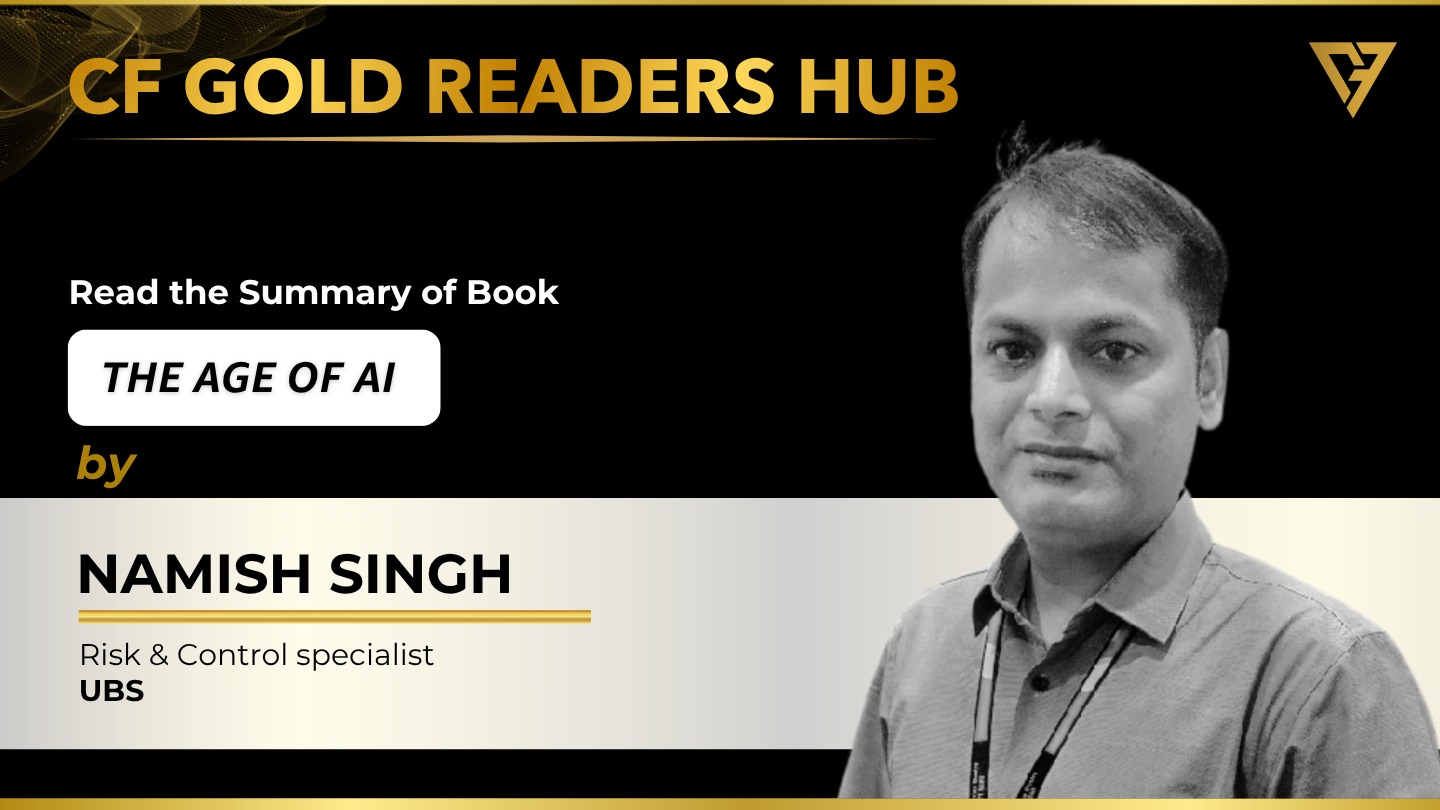
The Summary of the book "The Age of AI" by our Gold Member Namish Singh.
Book Overview
The Age of AI: And Our Human Future explains how Artificial Intelligence (AI) is changing the world and how it
may transform human life in the future. The book shows how AI will affect our thinking, decision-making,
politics, war, science, and even our understanding of reality. The authors tried to show perspectives from
politics, technology, and philosophy to show that AI is not just a new tool, it may become a powerful force that
reshapes human civilization.
1. The Beginning of a New Era
The authors argue that humanity is entering a new historical era called the Age of AI. In the past, humans
created tools like machines and computers that followed clear instructions. But modern AI systems can learn
from data and make decisions on their own.
For example, AI can now recognize images, translate languages, diagnose diseases, and drive cars. These abilities
show that machines are starting to perform tasks that previously required human intelligence. Because of this,
the authors say AI may change society as deeply as earlier revolutions like the Industrial Revolution.
2. How AI Thinks Differently from Humans.
Humans learn through experience, emotions, culture, and reasoning.
However, AI learns by analysing<large amounts of data using algorithms>. It can identify patterns very quickly,
but it does not truly understand things the way humans do.
For example, an AI system can beat world champions in complex games like chess. But it does not “think” about
the game like a human, it simply calculates the best possible move based on data.
This difference seen like a masterpiece <new type of intelligence>. We humans may start working alongside
machines that can make decisions or predictions that humans cannot fully explain.
3. AI and the Future of Knowledge
AI can process huge amounts of information much faster than humans. This means it can discover patterns in
science & technology, medicine, and research that humans might miss.
For example, AI may help scientists:
Ø Discover new medicines
Ø Predict diseases earlier
Ø Understand climate change more precise.
Ø Improve technology and engineering
However, the authors warn/emphasizes that if humans rely too much on AI, we may start <trusting results without fully understanding them>. And this could change how knowledge is created and verified.
4. AI and Security
One major topic in the book is <national security and warfare>. AI could significantly change how countries
defend themselves and fight wars.
Military systems might use AI for:
Ø Cybersecurity
Ø Autonomous drones
Ø Strategic decision-making
Ø Intelligence analysis
The Concerning point is that “AI could make decisions faster than humans”, which may increase the speed of
conflicts and reduce human control. If countries compete aggressively to build stronger AI systems, it could create new global tensions.
5. AI and Human Identity
The book also raises few Eye-opener questions. Humans have always believed that intelligence and reasoning
are uniquely human qualities. But if machines can perform similar tasks, it may challenge our understanding of
what it means to be human.
For example:
Ø If AI writes books or music, who is the creator?
Ø If AI makes medical decisions, who is responsible for mistakes?
Ø If machines become smarter in certain areas, what role will humans play?
The authors say We must carefully think about [ethics, responsibility, and human values] while developing AI.
6. Cooperation Between Humans and AI
Instead of replacing humans completely, AI will likely <work together with humans>. As humans provide creativity, judgment, and ethical understanding, while AI provides speed, data analysis, and pattern recognition.
This partnership could lead to great benefits:
Ø Better healthcare
Ø Smarter cities
Ø Safer transportation
Ø Faster scientific discoveries
The Need for New Rules and Thinking
The authors emphasize that society must “create new rules, policies, and ethical frameworks” for AI.
Governments, scientists, and companies should work together to ensure that AI benefits humanity rather than harming it.
The key message is that <AI development should be guided by human wisdom and responsibility>.
To Conclude:
[The Age of AI] explains that artificial intelligence is not just another technological innovation, it is a “turning
point in human history”. AI has the potential to greatly improve science, medicine, and daily life, but it also creates serious challenges related to security, ethics, and human identity.
The authors believe that the future will depend on how wisely humans manage this powerful technology. If
societies cooperate and create thoughtful rules, AI could help humanity achieve extraordinary progress. But if it
is used without responsibility, it may create new risks and uncertainties.
In simple terms, the book teaches that “AI will shape the future of humanity, and humans must guide it
carefully”.
📢 Want to be featured? Fill out the form and let us showcase your journey!